- The GEF is part of the financial mechanism to the BBNJ Agreement, supporting the conservation and sustainable use of marine biodiversity in areas beyond national jurisdiction.
- Ratification of the 60th and 61st countries to the BBNJ Agreement sets into motion its entry to force in 120 days.
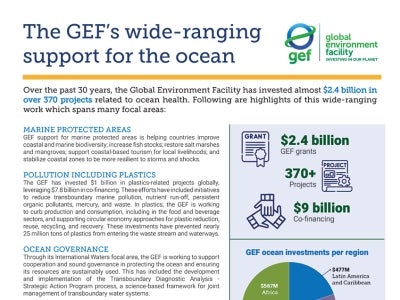
- The GEF has allocated $34 million for ratification support and implementation activities and is the largest multilateral public funder for oceans, having invested over $2.5 billion since 1992.
Global Environment Facility CEO Carlos Manuel Rodríguez celebrated on Friday the imminent entry into force of the agreement under the United Nations Convention on the Law of the Sea on the conservation and sustainable use of marine biological diversity of areas beyond national jurisdiction, known as the BBNJ Agreement, as an encouraging and essential step forward.
The breakthrough was achieved after Morocco and Sierra Leone deposited their instruments of ratification, moving the total number of parties across the 60-country threshold, and setting into motion entry into force of the agreement in 120 days, on Jan. 17, 2026.
“Conservation and sustainable use of the ocean are essential for a healthy planet and healthy people. It is very encouraging to see countries come together under the BBNJ Agreement,” said Rodríguez, a former environment and energy minister from Costa Rica. “The GEF stands ready to support countries with its implementation, including also building close relationships with the BBNJ Agreement COP and Secretariat, for a healthy global ocean.”
The BBNJ Agreement was adopted in June 2023 after nearly two-decade-long negotiations, which saw delegations coming together to agree on legally binding measures to manage and protect the ocean and its biodiversity from the threats it faces in areas beyond national jurisdiction, where no one nation has sole responsibility for management. Those areas make up 40 percent of the surface of the planet, comprising 64 percent of the surface of the ocean and nearly 95 percent of its volume.
To support the agreement, the GEF has allocated $34 million for GEF recipient country ratification support and implementation readiness activities. More than 50 countries have already taken advantage of this funding and are also benefiting from a global and regional project that complements national-level country assistance.
The GEF is the largest multilateral public funder for oceans, having invested over $2.5 billion since 1992. It serves as part of the financial mechanism to the BBNJ Agreement, supporting developing countries in promoting the conservation and sustainable use of marine biological diversity in areas beyond national jurisdiction.
The BBNJ Agreement is one of six multilateral environmental agreements that the GEF serves, including the Convention on Biological Diversity, the UN Framework Convention on Climate Change, the UN Convention to Combat Desertification, the Minamata Convention on Mercury, and the Stockholm Convention on Persistent Organic Pollutants. It will significantly contribute to achieving the ocean-related goals and targets of the 2030 Agenda for Sustainable Development and the Kunming-Montreal Global Biodiversity Framework.
The agreement focuses on four pillars: fair and equitable benefit-sharing from marine genetic resources and their digital sequence information; creation of area-based management tools, including marine protected areas; robust environmental impact assessment; and enhanced cooperation on capacity-building and marine technology transfer, with particular support for developing countries.
About the Global Environment Facility
The Global Environment Facility (GEF) includes several multilateral funds working together to address the planet's most pressing challenges in an integrated way. Its financing helps developing countries address complex challenges and work towards meeting international environmental goals. Over the past three decades, the GEF has provided more than $26 billion in financing, primarily as grants, and mobilized another $153 billion for country-driven priority projects.
Media Contact
Alexandre Pinheiro Rego
Senior Communications Officer
arego@thegef.org