
Main Issue
The pace of climate change is accelerating, bringing with it rising sea levels and more frequent and intense storms, droughts, and floods.
Extreme temperatures and weather events risk inflicting lasting economic and societal damage, particularly in the world’s least developed countries which are ill-equipped to guard against climate change and recover from its worst effects.
In 2001, the 194 parties to the United Nations Framework Convention on Climate Change (UNFCCC) set out to address this challenge by establishing the Least Developed Countries Fund (LDCF) – the only facility exclusively dedicated to helping these countries adapt to new climate realities.
The LDCF, along with the Special Climate Change Fund (SCCF), is mandated to serve the Paris Agreement. Both funds are managed by the Global Environment Facility.
Featured Content

GEF Council approves $700M+ for vast environmental needs
What We Do
The Special Climate Change Fund, one of the world’s first multilateral climate adaptation finance instruments, was created at the 2001 Conference of the Parties (COP) to the United Nations Framework Convention on Climate Change (UNFCCC) to help vulnerable nations in addressing these negative impacts of climate change.
The SCCF is managed by the GEF and operates in parallel with the Least Developed Countries Fund (LDCF). Both funds have a mandate to serve the Paris Agreement.
The GEF’s climate change adaptation strategy for the 2022-2026 period focuses SCCF support in the following two priority areas:
Supporting the adaptation needs of Small Island Developing States (SIDS)
The Small Island Developing States of the Caribbean, African and Indian Ocean, and the Pacific, are among the world’s most vulnerable countries, due to a range of climatic and non-climatic factors. Salt water intrusion is severely impacting availability of drinking water as well as agricultural productivity on many islands. Sea level rise will worsen this situation, especially on low-lying islands, and, together with increased heavy rainfall, worsen damage from tropical storms to coastal infrastructure, settlements, and coastal ecosystems. Compounding these impacts, solutions are often difficult owing to SIDS’ geographic isolation and limited land area. The Intergovernmental Panel on Climate Change Sixth Assessment Report refers to a range of projected adverse climate change impacts for SIDS, which will translate into direct adverse impacts on human security, health, infrastructure, ecosystems, agriculture and food, and the economy and livelihoods.
Some areas where the SCCF could offer adaptation support to SIDS include: storm and flood early warning systems; improved regional forecasts; nature-based solutions such as mangroves and other protective measures; enhanced resilience of roads, public infrastructure, and freshwater sources; climate-resilient aquaculture, fisheries, and diversified incomes; systemic resilience interventions in the food, urban and tourism space; climate resilient health (vector- and water-borne disease); and measures to build resilience, reduce fragility, and diversify the local economy, reducing dependence on imports; as well as mainstream climate resilience in policies and development planning; and build domestic capacity for adaptation.
Strengthening technology transfer, innovation, and private sector engagement
The SCCF facilitates the creation of strong, climate-resilient economies and communities by helping countries address a range of barriers, including:
- Limited access to climate-resilient technologies and infrastructure
- Limited institutional capacity to foresee and manage climate risks
- Low engagement by the private sector, including small and medium-sized enterprises and entrepreneurs, for developing and providing adaptation solutions
- Lack of access to finance from public sources and to markets for adaptation solutions.
Recent initiatives backed by the SCCF show these obstacles are far from insurmountable. Small farmers provided with equitable and localized lending can afford to invest in climate adaptation technologies. Incubators and targeted funds can attract private sector involvement in climate adaptation innovation. And cutting-edge tools such as artificial intelligence and drones can improve climate risk data, which can enable adaptation and resilience in a range of areas, including disaster risk mitigation, municipal budget planning, and the design of commercial lending products.
Results
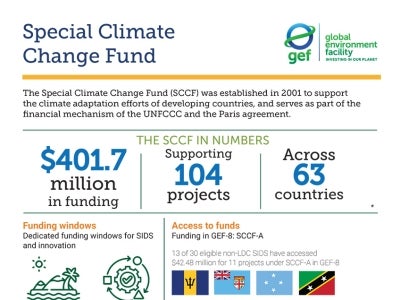
Since its inception, the SCCF has provided more than $393.8 million in grants for 101 projects. These have benefited approximately 9.5 million people, and helped bring over 5 million hectares of land under more sustainable management. Roughly one-third of SCCF initiatives are aimed at expanding access to improved climate information services. The SCCF is increasingly focused on supporting innovation that can scale up climate change adaptation solutions.
Activities funded by the SCCF have fostered improvements in agriculture, water resources, disaster risk management, infrastructure, climate information systems, natural resource and integrated coastal zone management, as well as climate change-driven disease prevention. SCCF financing has also bolstered the climate resilience of public infrastructure such as schools, roads, and ports, supported the development of catastrophe risk insurance, and supported small and medium-sized enterprises in the adaptation space.
SCCF projects cut across a range of sectors and geographies. For instance:
- A joint effort with the SCCF, the MAVA Foundation, the International Institute for Sustainable Development (IISD), and the United Nations Industrial Development Organization (UNIDO) is using financial modelling and climate change forecasts to demonstrate the real value of nature-based solutions to investors and governments. This initiative also offers opportunities for infrastructure projects to receive support for valuation of nature-based alternatives.
- The SCCF supported the launch of the Climate Resilience and Adaptation Technology Transfer Facility (CRAFT), the world’s first private sector investment vehicle for climate resilience and adaptation. CRAFT aims to catalyze $250 million in private sector investment for local climate adaptation action by showing it is possible to generate strong financial returns as well as significant societal benefits. It is also building awareness of the investment potential of tools such as weather analytics that can help assess and manage climate risks.
- The Challenge Program for Adaptation Innovation, funded by $10 million sourced equally from the SCCF and LDCF, was launched to support innovation and private sector engagement for climate change innovation. Its inaugural call for proposals in 2019 attracted almost 400 project concepts from more than 340 institutions. Nine successful proposals were announced at climate COP25. These included coral reef insurance in the Asia Pacific region; the use of drones to monitor landslides and debris in Colombia in partnership with MIT; and financing for cities seeking to improve their creditworthiness, issue green bonds, and ramp up asset recycling.
- An SCCF-funded project in the Caribbean (SOILCARE) is helping eight small island countries invest in improved soil management to address climate change and improve land quality. This project implemented by the Food and Agriculture Organization (FAO) is helping integrate adaptation into regional policies and plans, establish climate modelling on a regional scale, identify climate-resilient technologies, and build regional capacity and knowledge management.
- In 2020, the SCCF joined the Inter-American Development Bank (IADB) and Conservation International to fund the Adaptation SME Accelerator Program (ASAP), an effort to increase private sector engagement in climate adaptation. Led by the private investment firm Lightsmith Group, ASAP is helping small and medium-sized enterprises commercialize climate risk reduction measures and attract investors.
- In September 2020, ASAP released the Adaptive Solutions Taxonomy, a tool designed to help assess the adaptive technologies, products, and services that companies offer. This methodology can also help pinpoint what support a small or medium-sized enterprise needs and is designed for use by companies, investors, and public bodies.